"The Surrender has brought a big change": The Secret of the Telegian
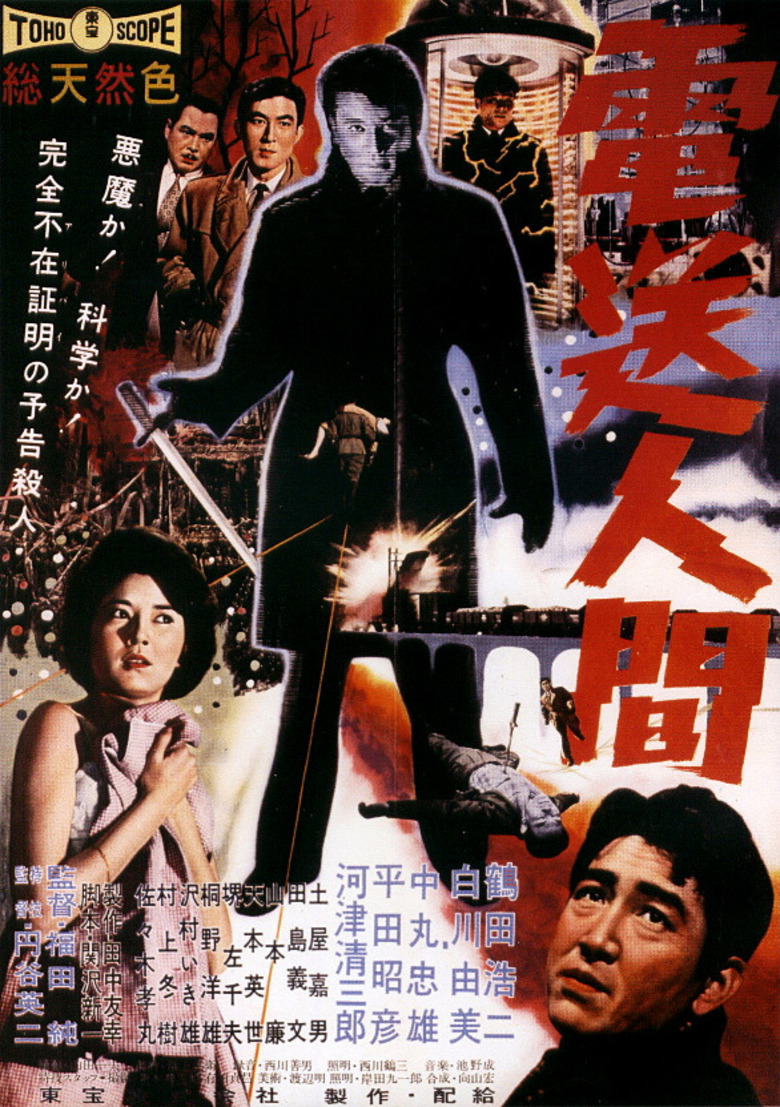
Info
Also known as: Electrically-Transmitted Human Being (Original Japanese); The Telegraphed Man (alternate Japanese translation, suggested by August Ragone); The Telegian (alternate translation); The Secret of the Electric Human (Brazil)
Director: Fukuda Jun. Screenplay: Sekizawa Shinichi. Director of Special Effects: Tsuburaya Eiji. Composer: Ikeno Sei.
Runtime: 85 minutes
Release Date: April 10, 1960
What’s It About?
A group of former war associates are being killed one by one by a glowing assailant who teleports in and out of the scene of the crime. Investigating the murders, science reporter Kirioka (Tsurata Koji) and police detective Kobayashi (Hirata Akihiko) discover an incident where four gold-smuggling soldiers left their compatriot Sudo (Nakamaru Tadao) and the professor they were escorting for dead at the end of the war. But the smugglers never found the bodies, and now it seems that Sudo is still alive and using the professor’s teleport invention to enact deadly revenge.
Monster Appearances: None. In spite of Secret of the Telegian’s place as the second of Toho’s “Mutant Trilogy,” Lance Corporal Sudo isn’t even a mutant, just a regular human using a teleport machine invented by Professor Nikki (Sasaki Takamaru); the blue shimmer that covers Sudo body at times is just a side effect of using the machine.
Childhood Memories
None, in fact, I’m not even sure I know the film exists until well into adulthood. I watch it during my Toho science fiction catch-up in Dublin, on March 8, 2019. It might be the sub-par English dub that is the only way I can find to watch the film, but I am largely unimpressed with it despite my general fondness for the director and screenwriter, feeling that they clearly hadn’t found their voices yet.
Analysis
We’re even farther afield from the giant monster film here than in Battle from Outer Space or The H-Man, this film’s predecessor in the Mutant Trilogy. As mentioned above, there are no true monsters in the film. (Indeed, the only thing that marks Sudo out from an ordinary man on the street is the late shock reveal that gasp! His face is scarred from the dynamite explosion meant to kill him and Professor Nikki! His deformity is a sign of his inner evil, you see!) This is not to deny Sudo his effectiveness as a villain; Takamaru gives a deliciously evil performance and the character’s ghost-like pallor lends him an eerie presence. But ultimately, he’s just a guy, not a kaiju. I’d probably have skipped The Secret of the Telegian altogether were it not for its grouping with The H-Man and the trilogy-capper The Human Vapor, and for the fact that Telegian marks yet another milestone for Toho’s science fiction films: the genre debut of one Fukuda Jun, directing only his second film after graduating from an assistant director position at Toho.
It would have been easy, by 1960, to assume that Toho’s science fiction films were synonymous with director Honda Ishiro’s science fiction films. All but two of them had been directed by Honda, and whatever Oda Motoyoshi’s strengths or weaknesses, it would be easy to forget that he had helmed Godzilla Raids Again and Toho’s 1954 Invisible Man film. In his tokusatsu film research book Age of the Gods, Guy Mariner Tucker speculates that Honda’s strong association with their special effects productions is exactly why Toho brought on Fukuda instead of Honda, as a way of demonstrating that the directors were separate from the brand. (Ironic, then, that 1960 was also the year they would stop assigning Honda anything but science fiction films in all but two cases going forward.)
We won’t see Fukuda pop up again for a while, but he’ll go on to be a major figure in the Godzilla series, helming five of the films between the mid-sixties and mid-seventies - the most entries to date after Honda himself. And unlike Honda, whose greatest works are generally respected even by those who don’t take to his at-times aggressively straightforward directing style, Fukuda’s work remains contentious among kaiju fans and film critics alike, associated as it is with the changing direction of the genre in the second half of the sixties and beyond. As such, there are doubtlessly those who view Fukuda’s science fiction debut here as a poisoned chalice, a dark sign of things to come. We’ll examine Fukuda’s impact and legacy in good time, but it’s worth noting off the bat that the director acquits himself fairly well here, especially given his relative inexperience. (In fact, Telegian was Fukuda’s earliest film to see release. The Terrible Game, a violent delinquent youth film that was his true directing debut, had offended the sensibilities of the Toho executives that assigned him to it, prompting them to withhold it from screening).
Right from the opening murder set in a colorful haunted attraction, Fukuda demonstrates a flair for immediacy in keeping with Honda’s “you are there” approach to the action, but his own approach is different. Where Honda generally favored straight-on camera framing, preferring to allow the action to speak for itself, Fukuda’s visual approach is often looser and more dynamic. In the opening murder sequence, Fukuda employs tilted angles, frequent close-ups, and discontiguous editing to convey the spooky thrills of the haunted tunnel and the actual murder that takes place there. Throughout the film, the director continues to use the camera to express the action and atmosphere rather than simply capture them, frequently utilizing additional choices such as Dutch angles. Even his dialogue scenes, shot with simpler coverage in the vein of Honda’s films, tend to incorporate more camera movement (such as tracking shots) than in Honda’s work. In the then-contemporary Japanese film landscape, Fukuda’s style feels closer to the spirit of Kurosawa Akira’s adventurous camerawork than the stately approach favored by Honda and exemplified to the furthest degree by directors such as Ozu Yasujiro, whose late films almost exclusively favored static, horizontal shots. This isn’t to say that Honda didn’t demonstrate his own stylistic flourishes (such as the excellent falling POV shot during the tower collapse in Gojira), but Fukuda’s greater degree of experimentation marks him out as a distinct voice from Honda, far more than Oda Motoyoshi’s solid but anonymous approach had.
Another area in which Fukuda’s direction stands out is his ease with the subject matter. Bluntly, Fukuda demonstrates far more comfort with the sordid elements of the crime thriller than Honda did on The H-Man; certainly, one need only compare the camera’s enthusiastic close-ups on this film’s dancing nightclub woman (painted entirely gold, prefiguring Goldfinger’s most iconic visual by three years) to Honda’s uncertain engagement with male gaze-pandering in the previous film. Beyond that, Fukuda generally seems more comfortable with the seedy, grubby atmosphere here. Based on Telegian, it isn’t surprising that Fukuda would make his name at Toho with numerous crime films before being assigned more special effects productions. Both Fukuda’s association with “low art” genre material and his more gonzo directorial style are likely factors in why he would accrue the reputation of a junkier and lesser director than Honda, who had maintained a career as a serious drama film director alongside his special effects productions up to this point.
And yet for all its artistic differences, The Secret of the Telegian is very much of a piece with The H-Man in being a crime thriller with explicit ties to contemporary Japanese politics. Why the base genre of the Mutant Trilogy is crime as much as science fiction is uncertain, other than the speculation that crime stories were seen as a fitting subject for human-sized monsters. It’s equally uncertain what it says that both films would be among the most openly political of Toho’s science fiction films. Of all the kaiju films, The H-Man was the most explicit to date in linking the origins of its monsters to American nuclear tests and specifically the Lucky Dragon No. 5 incident. And here, The Secret of the Telegian is more direct than any of the films have been in addressing the legacy of World War II.
In fact, this is the first time in any of these films that World War II has been dramatized, period. The sepia-tinted flashback at the center of the film takes place on none other than August 15, 1945. On the night of Japan’s surrender, a band of five soldiers led by Onishi (Kawasu Seizaburo) transport Dr. Nikki and a chest full of his research to safety through a cave tunnel. But four of the soldiers are smuggling stolen army gold inside the chest, and when they drop the chest and reveal their plot, their fifth member, Lance Corporal Sudo, objects over the barrel of his gun. Sudo’s traitorous comrades mortally wound him and Nikki, but are forced to leave the gold behind to avoid being killed by the dynamite charges they’ve set to seal off the cave. When Onishi and his men return to search for the gold, they find no trace of it or the bodies…because of course, Sudo and Professor Nikki survived, and have used the ill-gotten gold to fund Nikki’s teleport machine that Sudo is using to kill the men who betrayed him and the army he fought for.
It’s worth noting the exact motivations of the key players here. While Onishi’s rationalization of his theft can easily be dismissed as a cover for mere greed, there’s a grain of larger foresight in his words*: “Don’t you know the war’s over? There’s no reason to continue [Nikki’s] research. The surrender has made a big change. Money will be the important thing from now on, and it’s each man for himself.” In other words, Onishi foresaw the post-war order of Japan, which ultimately saw the country reemerge as a standard western-style capitalist nation on the world stage.
In the present day, we see that Onishi’s foresight has served him well as the owner of a cabaret nightclub. And not just any cabaret: the establishment is military-themed, with bouncers dressed as soldiers, hostesses dressed as sailors to represent the Navy, and house special beverages with names like Hand Grenades and Missiles, and food referred to as “rations” that are “transported” over by the waitresses. The theme is striking for what it suggests about the perception of World War II in Japan by that point. In Gojira, the wound of the Pacific War was still raw, reopened afresh by events such as the H-Bomb tests and the fate of the Lucky Dragon No. 6. A mere six years later in 1960, close to when the first generation born after the 1945 surrender would be coming of age or near to it, and the war has become historicized enough that the Imperial forces can be used as the theme for a kitschy nightclub without any characters making comment. The Pacific War has faded into the past enough that it has become just another set of signifiers that can be repurposed to sell novelty and, perhaps, nostalgia via the same mercenary mindset with which Onishi and his co-conspirators trafficked gold.
Perhaps this is the simple answer to the “why now” regarding the Mutant Trilogy’s explicit engagements with World War II: enough time had passed. Gojira addressed the war and its aftermath primarily through allegory, with producer Tanaka Tomoyuki even vetoing more explicit topical references by the script as unsuitable for general audiences looking for entertainment. But Gojira was released at the dawn of Japan’s post-Occupation economic boom; several years later, with a new decade around the corner, that economic boom was in full swing. The nation was heading further away from the war and into a new era. At least on the surface, the wound was less raw than it had been. Time heals, as they say, and being in the midst of economic growth would certainly seem to sweeten the process.
And yet, Telegian posits that the scars of the war were very much present, no matter how much its iconography was repurposed and sanitized by individuals such as Onishi. After all, the specter of the war literally haunts Onishi and his compatriots in the form of their main opposition, Sudo. In the flashback, Sudo justifies his opposition to the gold smuggling in moral terms, protesting that “Those gold bars belong to the people of this country. It’s not right for you to steal them because of the Surrender.” On the surface, Sudo’s motivations may seem pure, fueled by loyalty to his people, his army, and his nation. But in the present of 1960, while Sudo’s ire is well-earned and his targets are hardly stand-up human beings, the man himself is no angel. He’s willing to kill anyone who stands in his way and leers threateningly at Chujo, the female lead (played by Shirikawa Yumi).
The final key player in the flashback is Sudo’s one ally, Dr. Nikki. The doctor, when discovered to be alive and in hiding by the protagonists, is revealed to have been even more injured than Sudo by the cave-in and is confined to a wheelchair. The surprise turns out to be that, even though his injuries are worse than Sudo’s, the scientist doesn’t seem to bear a grudge. Nikki seems to have been perfectly content to live in hiding with Sudo and build his miraculous invention in peace for the last fifteen years. While Nikki expresses similar patriotic sentiments that Sudo had before the cave-in, he turns out to have been unaware of Sudo’s plan of vengeance altogether, which eventually proves his undoing as Sudo turns on him for standing in his way.
Dr. Nikki’s lack of desire for vengeance in spite of his injuries puts him in contrast to Sudo; we can conclude that the latter’s bloodthirstiness comes not from what he suffered, but from his staunch belief in his cause. For all his claims to the moral high ground as the “good” imperial soldier, Sudo was ultimately just as ready to commit barbaric acts as those who betrayed him: all of them symbols of a military order that was ready to exploit and sacrifice fellow countrymen such as Nikki. In his innocent naivete, Nikki provides additional contrast with another brilliant scientist from these films: Gojira’s Dr. Serizawa, who is tacitly recalled here through the presence of his actor, Hirata Akikiko, as the co-lead.
Serizawa, after all, was wracked with despair over the knowledge that his scientific invention could and would be used for terrible purposes in the era of the Cold War, a practical despair that seems to have been born from his implied experiences in World War II. In comparison, Dr. Nikki displays no evidence of having had to grapple with the potential negative applications of his work, and indeed he somehow spent a decade-and-a-half in seclusion with Sudo without picking up on his roommate’s murderous lust for vengeance. (The exact level of closeness involved in their living arrangement is left unaddressed; any slash fic writers out there who are into long-forgotten Japanese genre films, take note.) Nikki is a version of Serizawa who never grew beyond blind idealism for his work. He is just as much of a living ghost as his partner, haunting the new decade to come; if Japan’s militaristic past lives on in the shadows, then so does the opportunity for the poison fruit of scientific progress to result in catastrophic misuse, as long as individuals like Nikki don’t question the ramifications of their work. A timely message for a nation in a period of growth, facing an onrushing future.
And so we have a film at the turn of the decade that posits that Japan has materially moved on further from the war since Gojira but still carries its scars, inflicted within and without, with the potential to become open wounds once more under the right circumstances. Even if The Secret of the Telegian was not consciously intended to serve as a transition from the fifties into the sixties ahead for Toho’s science fiction films, it proved a particularly apt one. And with Telegian, Toho demonstrated that there were voices distinct from Honda’s that could be successfully added to the mix. Maybe not to outright spectacular effect, at least not yet; for all that Telegian coheres better as a narrative than The H-Man’s split genre threads did, it lacks the thrillingly spooky highs that Honda’s film captured at its best. But this was, after all, only Fukuda Jun’s second film. He acquitted himself well enough at this stage to demonstrate that Toho’s science fiction had room for more voices than just Honda’s.
But in the meantime, Honda himself would return to conclude the Mutant Trilogy with one of the unsung gems of his career.
*At least according to the international english dub, which is currently the easiest way to find the film.


Comments
Post a Comment